
What We Learned Before Games Held Our Hands
Ocarina of Time, millennial patience, and the quiet art of figuring things out

Just the other day, my sibling group chat started off with rising gas prices and somehow ended with gamers, which has essentially become the norm for us. In between, we somehow covered elected officials, news sources, education, funding cuts, healthcare, AI, and a few other topics. One topic turns into another, someone asks a question, someone pushes back, someone makes a joke, and before long we’re somewhere none of us planned to be, but somewhere we wanted to be.
As millennials who grew up with that era of games, we seemed to agree that the games we played asked something different of us. Less handholding. Fewer hints. More trial and error. More patience. The agreement was funny, but I don’t think it was only funny.
What stood out afterward was the way we talked.
I love my siblings, and I’m grateful for the way we’ve learned to talk to each other. Our group chat feels like a safe space, but not because we avoid hard topics or agree on everything. We don’t. It feels safe because there’s an understanding that we can be honest without being cruel. Passion is allowed. Honest feelings are allowed. Authentic expression is allowed. Disrespect isn’t.
Respect is what makes disagreement possible without making anyone feel attacked.
I can’t recall if we were always this way. Looking back, it feels like we were, but I also know I appreciate it differently now that we’re adults with separate lives in different places. We have different responsibilities, different pressures, and different ways of seeing the world. But there’s still a common foundation underneath all of it. We grew up in the same house, played some of the same games, and seem to have carried forward a shared understanding that disagreement does not have to become disrespect.
Which is probably why the gaming part stuck out to me.
Not because we landed on some serious academic conclusion about millennial superiority. We didn’t. I’m not even going to pretend we were neutral observers. We were the millennials in the conversation, so of course part of us thought the games were better. But the more useful point is that we all agreed they were different in ways that shaped how we learned to approach problems.
I know “things aren’t made like they used to be” is not usually the direction I want to go at 37. But apparently this is how it starts. One day you’re playing Nintendo 64 ignoring homework. The next day you’re wondering whether modern games are negatively impacting cognitive development.
And honestly, I don’t think that concern is completely ridiculous.
That doesn’t mean every game needs to be punishing or confusing. It doesn’t mean every player should have to suffer through bad design just to prove something. But the games we grew up with did not hold our hands in quite the same way. They gave you a world, a controller, maybe a clue or two, and then expected you to figure things out.
Sure, there were instruction manuals, and sometimes they helped. But the real work still happened inside the game. You wandered. You tested things. You missed something obvious. You doubled back. You got frustrated. You tried again. Sometimes you stopped playing for a while because the game was not going to solve the problem for you, and apparently neither were you at that moment.
For me, the game that represents this best is The Legend of Zelda: Ocarina of Time, and more specifically, the Water Temple.
I don’t remember exactly when we got Ocarina of Time. I don’t remember the first time I played it. I barely even remember finishing the game. What I remember most clearly is getting stuck.
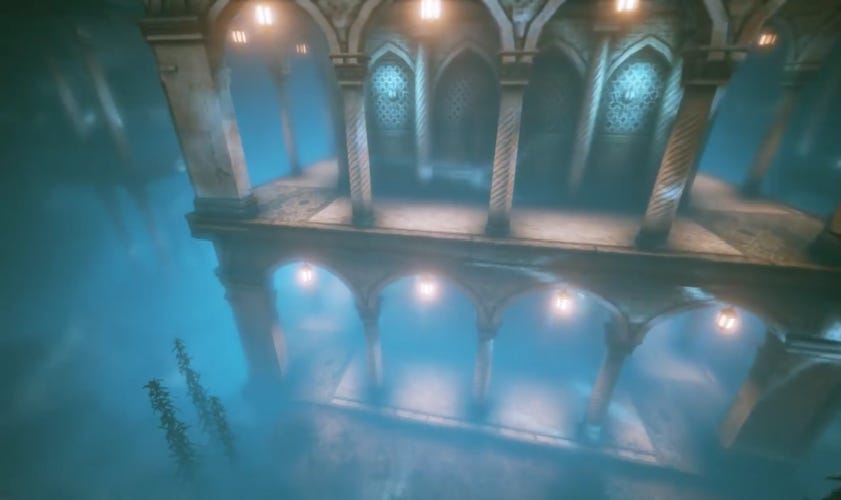
If you played it, you probably understand why. If you didn’t, the simple version is that the Water Temple was not frustrating because it required some impossible reflex or because there was one overly difficult enemy. It was frustrating because it required you to understand a system. You had to change water levels, move through rooms that opened or closed depending on those changes, remember where you had already been, and notice what looked different when you came back through the same space from another angle.
I’m sure child-me believed that stupid temple was designed with the specific purpose of ruining my life. I don’t remember enough detail to defend that position now, but I’m confident I felt very strongly about it at the time.
Eventually, I stopped playing for a while. I played other games. I let it go, at least as much as a kid can let go of being personally offended by a dungeon in a video game. Then, at some point, I came back and figured it out.
I remember that more clearly than I remember beating the game.
The funny part is that walking away may have been the lesson.
At the time, it probably felt like giving up. Looking back, it seems more like the first version of problem-solving I had available. I didn’t come back with some brilliant new strategy. I came back without carrying the same frustration into every attempt. I could look at the temple again, notice what I had been missing, and stop trying to force the same approach.
That probably influenced me more than I realized.
I think those games helped me practice problem-solving in a way that was really critical thinking before I would have called it that. You tested an idea, paid attention to what changed, remembered what didn’t work, and tried a different approach when the same one kept failing. That sounds simple now, but as a kid, it was not always obvious. Sometimes it just felt like being stuck in a temple and getting to a point you wanted to throw the controller through the TV screen.
Research supports some of this, though not all of the conclusions my siblings and I came to. Games don’t magically make people better thinkers. But research on video games and learning does suggest that certain kinds of games can support attention, problem-solving, cognitive flexibility, and decision-making. That makes sense to me. The right kind of game asks you to keep track of information, test assumptions, respond to feedback, and adjust when your first plan doesn’t work.
Or maybe that’s not entirely accurate. Maybe the game isn’t doing the teaching by itself. Maybe the game creates the conditions where the player has to practice.
I’m no game developer, but I do think there’s power in what a game is designed to ask of the player.
Because my concern now is not just about games. It’s about how many systems seem less comfortable letting people spend time between confusion and understanding. Games give more hints. Schools and grading systems can sometimes make it easier to move along without going deeper. Workplaces prize efficiency. AI can produce a response before you have fully figured out what you are asking.
Systems give us easy answers because they keep us moving. Over time, we learn to reach for them faster.
I don’t say that as someone who rejects help or technology. I use AI, and I value it. It has helped me prepare for my Associate Emergency Manager certification exam, better understand continuity concepts, and develop a situational awareness tool. Used well, I believe AI can expand what a person is capable of learning and building. But that only works when it keeps you engaged in the work.
AI can function a little like an in-game hint. Used at the right time, it can help you keep moving when you’re actually stuck. Used too quickly, it can point you past the part where critical thinking develops: testing what you know, noticing what doesn’t work, remembering what you have already tried, and changing your approach.
That’s the part I worry about. And based on our conversation, I don’t think I’m the only one.
I’m not trying to sound an alarm. I just worry that we’re getting less practice figuring things out without being pointed toward the answer. Not because every hint is bad. Not because help ruins learning. But because there’s a difference between getting help after you’ve worked through a problem and being guided past the hard part before you’ve had much time to think.
I see that in myself now. I’m more self-aware than I used to be. I can usually tell when I’m trying to force something that isn’t working, and I’m better at stopping before frustration takes over. I don’t always do it perfectly, but I’m more willing to reassess what I’ve already tried and change my approach instead of pushing harder in the same direction.
I don’t think Ocarina of Time gave me that self-awareness. A lot more life had to happen for that. But it gave me early practice in a method: try, observe, remember, adjust, and try again.
That’s not a bad thing to learn from a video game, and I wish my parents understood that at the time so they would have let me play more. But I digress.
Maybe that’s what my siblings and I were really talking about, even if we got there by way of gas prices, healthcare, AI, and education. We were not just being nostalgic for old games, although we were definitely doing some of that. We were talking about the way certain experiences taught us to approach difficulty. The way being stuck did not always mean something was broken. Sometimes it meant we had not understood the system yet.
I don’t want to turn every childhood memory into proof that everything used to be better. But I also don’t want to ignore the fact that some of those games made me work harder before they helped me move forward.
I think there’s value in that.
There is value in being lost long enough to start paying closer attention. There is value in trying the wrong thing and realizing that it’s wrong. There is value in walking away from the Water Temple and coming back later, not because the game will change, but because you can then approach it differently.
Maybe that is why I keep thinking about the conversation. It started as a wandering family discussion and ended with a joke about millennial gamers, but somewhere underneath it was something more serious about patience, critical thinking, easy answers, and the people we become when we have to figure things out.
Mostly, though, it made me grateful for my siblings.
Not because we agree on everything. Not because every conversation is thoughtful. Some of them are ridiculous, and I’m sure that’s part of why they work. But I’m grateful that we can still talk this way. We can be passionate without being cruel. We can disagree without trying to hurt each other. We can move from gas prices to public life to AI to video games and still understand that the relationship matters more than winning the point.
I think it’s safe to say I learned a little bit of patience from the Water Temple in one way. I can see it with my siblings in another: in the way we keep talking, keep listening, and keep making room for each other, even when we don’t agree.
As always, stay safe, stay informed, and let’s keep looking out for one another.
— Thomas